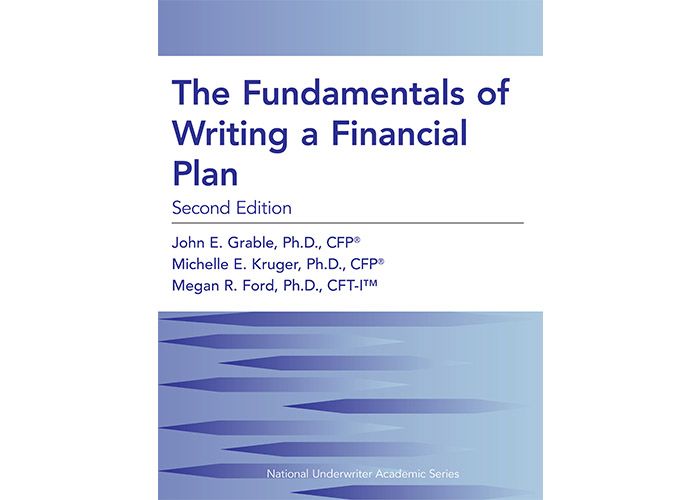
The Fundamentals of Writing a Financial Plan, 2nd Edition provides a totally revised and unique approach to helping aspiring financial planners write a comprehensive financial plan. The book outlines how the CFP Board of Standards, Inc. 7-step planning process can be applied when writing a comprehensive financial plan for an individual or family.
Need this and The Case Approach to Financial Planning titles? Grab the bundle here!
The book not only highlights various elements involved in comprehensive financial planning, including estate, tax, cash flow, education planning, and much more-but also introduces important behavioral perspectives and communication techniques. As a way to synthesize these pieces and learn how the plan writing process unfolds, students follow a running case-the Hubble family.
This title features:
A thorough review of the new 7-step systematic financial planning process.
A description of the regulatory environment in which every financial planner operates.
An in-depth discussion of client communication and counseling techniques.
Financial planning approaches that can be applied to a variety of clients and client circumstances.
A chapter-by-chapter focus on analytical tools and techniques that can be used to evaluate client data.
An example of a complete written financial plan with explanations about how analyses lead to the recommendations.
Chapter-based learning aids, including access to a fully integrated Financial Planning Analysis Excel package and other online support materials, including video examples of client communication and counseling strategies.
Instructions on how to do calculations essential to creating a financial plan.
Numerous self-test questions to test comprehension of material.
New in the 2nd Edition:
Updated materials that address CFP Board's new Client Psychology learning outcomes.
Videos that can be used to illustrate client communication and counseling techniques.
Revised and expanded test bank.
Updated Excel package.
Topics Covered:
CFP Board's 7-step financial planning process.
Step-by-step guide to formulating a financial plan and presenting it to a client.
Guides for different types of financial planning such as life insurance planning, long-term care insurance planning, and retirement planning.
Comprehensive Hubble case.
And More! See the “Table of Contents” section for a full list of topics
Professor and Athletic Association Endowed Professor of Financial Planning, University of Georgia
Professor John Grable teaches financial planning courses at the University of Georgia, where he holds an Athletic Association Endowed Professorship. Before his academic career, he worked as a pension and benefits administrator and later as a Registered Investment Adviser at an asset management firm. Dr. Grable has contributed to the profession of financial planning in numerous ways. He founded the Journal of Personal Finance and co-founded the Journal of Financial Therapy. He was also a founding co-editor of Financial Planning Review and served as the interim editor of Financial Services Review. He is well-known for his research in financial literacy and education, financial risk tolerance assessment, behavioral financial planning, and evidence-based financial planning. Dr. Grable has received numerous research and publication awards and grants focused on promoting the connection between research and financial planning practice. Over the past quarter-century, Dr. Grable has published over 200 refereed papers, coauthored several textbooks, coauthored a book on financial planning communication skills, co-edited a book on financial planning and counseling scales, coauthored a book on financial services ethics, and contributed to a graduate-level personal finance book. Additionally, Dr. Grable has served on the Board of Directors of the International Association of Registered Financial Consultants (IARFC) and held leadership roles with the American Council on Consumer Interests (ACCI) and the Financial Therapy Association. His contributions to the profession have earned him several awards, including the prestigious Cato Award for Distinguished Journalism in Financial Services, the IARFC Founders Award, the Dawley-Scholer Award for Faculty Excellence in Student Development, and the ACCI Mid-Career Award. When not teaching and publishing, he provides research and consulting services through the Financial Planning Performance Lab.
MEGAN R. FORD, M.S., LMFT
ASPIRE Clinic, University of Georgia
Megan Ford has served as the Clinic Coordinator of the University of Georgia’s ASPIRE Clinic since 2011. The ASPIRE Clinic, a unit of the College of Family and Consumer Sciences (FACS), is a first-of-its-kind interprofessional training clinic that joins together the collaborative service areas of therapy, financial planning, nutrition, and law. Megan leads an unparalleled experiential opportunity at the ASPIRE Clinic for both graduate and undergraduate students in FACS through direct service learning, helping both the Athens community as well as the UGA community access low- or no-cost services. For her work and leadership, Megan was recently named one of FACS’s 100 Centennial Honorees to acknowledge her commitment to the ideals of the college and for being instrumental in serving students. In addition to her full-time work at ASPIRE, Megan is currently pursuing a doctorate in Financial Planning, Housing and Consumer Economics at the University of Georgia. Before coming to the UGA, she earned a Master’s degree in Family Studies and Human Services with an emphasis in Marriage and Family Therapy from Kansas State University and a Bachelor’s degree in Psychology from the University of South Dakota. With a unique blend of education and practice experience in both therapy and financial planning, Megan has become a leader in the emerging field of financial therapy. Megan served as president of the Financial Therapy Association (FTA) from 2016-2018 and is the former copy editor for The Journal of Financial Therapy. Remaining active with the Association, she also serves as Chair of the FTA Regulatory Committee and has been integral in the development of the FTA’s financial therapy certification program. She is the author of the blog, Finding Harmoney, which explores the dynamics of money and relationships, and her thoughts have been featured nationally and internationally in the New York Times, Consumer Reports, CNN Money, Time Money, BBC, Financial Advisors Magazine, and more.
MICHELLE E. KRUGER
The University of Georgia
Michelle Kruger is a Ph.D. candidate with a concentration in Financial Planning at The University of Georgia (UGA). She graduated magna cum laude with a B.B.A. in Finance from the Terry College of Business at UGA in 2015. Michelle teaches classes in computer application in financial planning, as well as advanced financial planning seminar courses. Her research interests include financial planning interventions, risk tolerance assessment, and behaviors associated with building wealth. In addition to her graduate studies, Michelle works as a research assistant at the Financial Planning Performance Lab, the nation’s only applied clinical facility designed to obtain evidence about the effectiveness of the financial planning process. She has worked as a financial planning analyst at Elwood & Goetz Wealth Advisory Group, a fee-only, comprehensive financial planning firm located in Athens, Georgia. She also has served as a financial counselor at the Aspire Clinic, an interdisciplinary teaching and research institution, applying marriage and family therapy theories and techniques to her work with financial clients.

 M.D.
M.D.